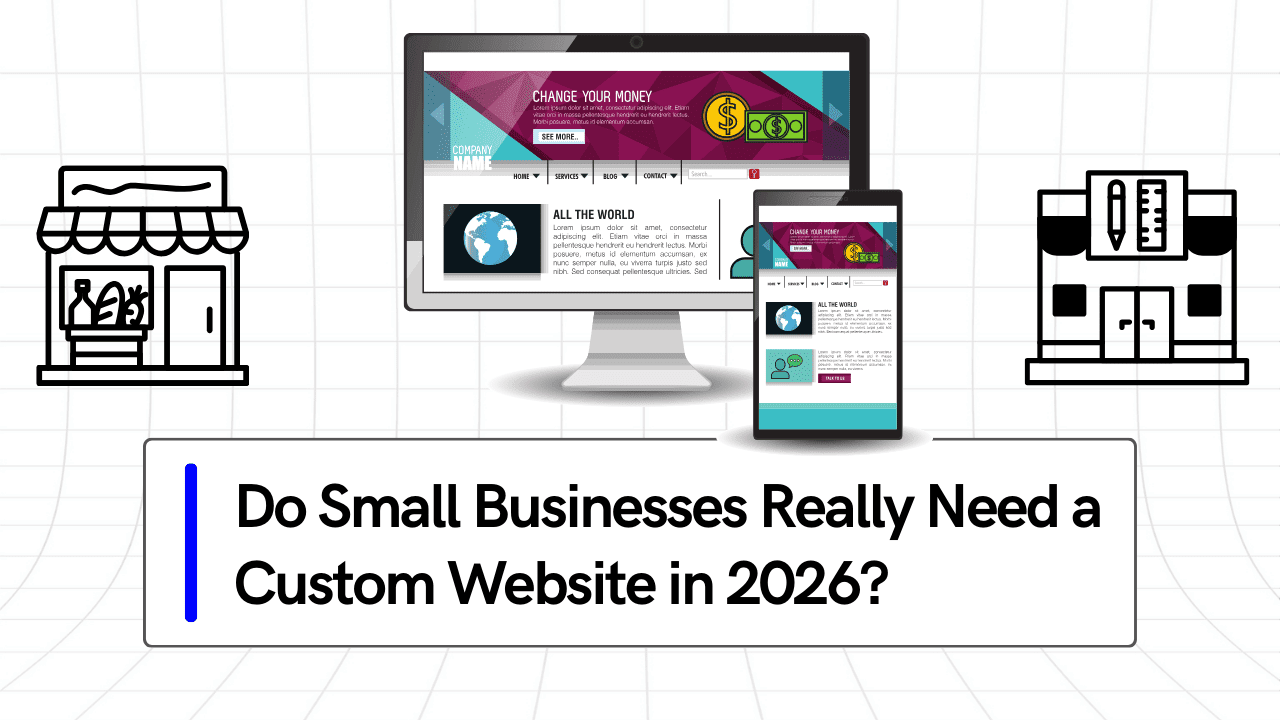
Do Small Businesses Really Need a Custom Website in 2026?
The digital world in which small businesses operate in 2026 is more competitive and platform-dependent than it has ever been. While social media, online marketplaces, and website builders have made it simple to create an online presence, they have also raised questions about what is actually required for sustained business growth.
Many business owners frequently wonder if social media pages and pre-made templates are sufficient, or if a custom website is still necessary. Based on growth, control, scalability, and return on investment, this article offers a useful, business-focused solution.
Understanding What a Custom Website Means in 2026
In 2026, a custom website entails more than just an eye-catching layout. It describes a website created especially to support business goals like sales, lead generation, automation, and search engine visibility.
A modern custom website typically includes:
- Structured pages designed for conversions
- Search-engine-friendly architecture
- Optimised page speed and performance
- Integration with enquiry forms, WhatsApp, CRM, or booking systems
- Scalability for future business needs
This is different from generic templates that focus mainly on appearance rather than functionality.

Situations Where a Small Business May Not Need a Custom Website
Not every business needs a custom website right away. In certain situations, a more straightforward solution might be adequate in the short run.
Examples include:
- Early-stage businesses validating an idea
- Sole proprietors relying only on referrals
- Temporary or seasonal operations
- Businesses with extremely limited budgets
In such cases, a basic website or landing page can help establish initial visibility. However, these setups often become limiting once the business starts to grow.
Connect With Us for WordPress Website Development – Connect Now
When a Custom Website Becomes Essential
For most small businesses, a point arrives where a custom website is no longer optional.
1. Search Engine Visibility and Organic Leads
Customers searching on search engines already have intent. A properly structured website allows a business to appear for relevant searches and attract potential customers without ongoing advertising costs.
Social media does not provide this type of long-term discoverability.
2. Business Control and Ownership
Social media platforms are controlled by third parties. Algorithms, policies, or account restrictions can change at any time.
A website provides:
- Ownership of content
- Control over customer data
- Stability independent of platform changes
This level of control is critical for long-term operations.
3. Automation and Operational Efficiency
In 2026, customers expect quick responses and seamless processes.
A custom website can automate:
- Enquiry handling
- Appointment booking
- Payment collection
- Follow-up communication
This reduces manual workload and improves customer experience.
4. Scalability and Growth
A custom website serves as the cornerstone that enables businesses to grow into new services, locations, or advertising channels. As requirements grow, templates frequently struggle with performance, SEO structure, and sophisticated integrations.
Custom Website vs Templates vs Social Media
From a business perspective, each option serves a different role.
A website:
- Builds long-term organic traffic
- Converts high-intent visitors
- Supports automation and analytics
Social media:
- Generates short-term attention
- Depends heavily on algorithms
- Requires continuous effort
Templates:
- Offer quick setup
- Limit flexibility and performance
- Often require rebuilding later
Most successful businesses eventually transition from templates and social platforms to a structured website.
Trust, Credibility, and Customer Perception
Businesses with a polished and educational website are strongly preferred by consumers in 2026. A website conveys credibility, stability, and seriousness.
This is especially important for:
- Service-based businesses
- Local businesses
- High-value or specialised offerings
A strong website directly influences trust and decision-making.
Cost vs Long-Term Value
The cost of a custom website is often viewed as an expense. In reality, it is infrastructure.
Without a proper website, businesses may experience:
- Missed enquiries
- Low trust from potential customers
- Poor search visibility
- Increased dependency on paid advertising
A well-built website helps reduce these losses over time and supports sustainable growth.
How Successful Small Businesses Use Websites in 2026
High-performing businesses treat their website as the central system of their digital presence.
- Social media drives traffic
- The website converts visitors
- Automation improves efficiency
This integrated approach delivers consistent results and reduces reliance on any single platform.
Final Conclusion: Do Small Businesses Really Need a Custom Website in 2026?
It’s not necessary for every small business to start with a completely unique website. However, a custom website becomes a strategic requirement for companies looking to expand, generate steady leads, and run smoothly.
- A website is more than just an online pamphlet in 2026.
- It is a business tool that facilitates scalability, automation, visibility, and trust.
Small companies are better positioned to compete and expand sustainably when they make the right website investment at the right time.